Homesick for a City That Never Existed: City Pop and the Nostalgia Industry's Greatest Trick
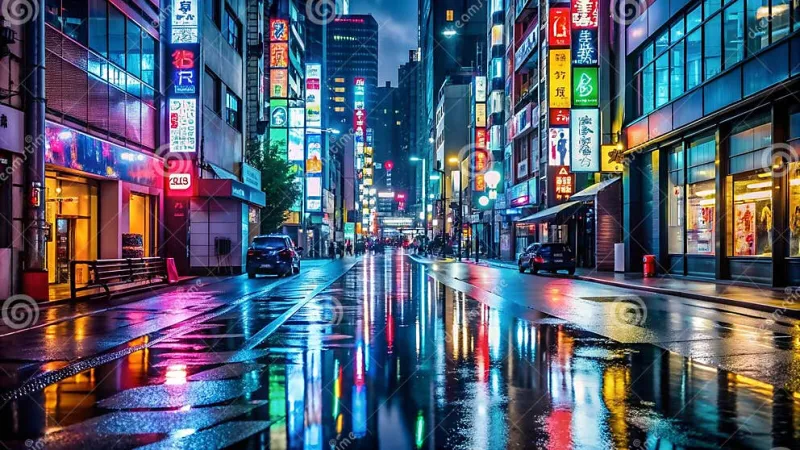
Photo: 1980s Tokyo neon city street at night rain retro aesthetic, via thumbs.dreamstime.com
Somewhere between 2017 and now, an enormous number of Americans developed a very specific ache: a longing for neon rain-slicked streets, a Toyota Soarer, a boombox playing saxophone-drenched funk, all of it located in Tokyo, all of it from roughly 1984. A decade we never lived. A city most of us have never seen.
The soundtrack for this manufactured homesickness is city pop — the glossy, jazz-fusion-inflected pop music that Japanese studio musicians made for a bubble-economy audience flush with yen. Tatsuro Yamashita, Mariya Takeuchi, Toshiki Kadomatsu. Music engineered to sound like the future, now heard exclusively as the past.
How a Dead Genre Got Resurrected by a Playlist
The revival story is now folklore: in 2017, a YouTuber uploaded Plastic Love by Mariya Takeuchi. The algorithm did its work. Lo-fi edits, VHS-filtered montages, and eventually the entire aesthetic apparatus of "vaporwave's sophisticated older cousin" followed. A genre that had been critically dismissed in Japan as dated commercial fluff became, in the West, the sound of an entire imagined era.
What's worth sitting with is what kind of nostalgia this is. Classic nostalgia is for something you experienced. This is closer to what scholars call anemoia — longing for a time you never knew. And crucially, the time we're longing for never quite existed even for the people who lived it.
The Bubble Was Real; the Aesthetic Was Always a Fantasy
Here's the thing about 1980s Tokyo that the VHS grain hides: city pop was the soundtrack of speculative wealth. The bubble economy was a collective hallucination of endless ascent — land prices reaching absurdity, corporations buying impressionist masterpieces, ordinary salaried workers taking out hundred-year mortgages. The music's effortless, air-conditioned smoothness wasn't capturing Tokyo life; it was scoring the fantasy Tokyo was telling itself.
When the bubble burst in the early nineties, the genre collapsed with it. Japanese listeners heard city pop and felt the specific embarrassment of a crashed party. Americans in 2024 hear it and feel longing. Same songs, opposite emotional valence. That gap might be the most interesting thing about the whole revival.
What We're Actually Nostalgic For
Strip away the romance and the timing tells the story. City pop hit the American zeitgeist at the exact moment our own relationship to the future curdled — climate dread, platform decay, a housing market that makes hundred-year mortgages sound less absurd than they should. Of course a generation raised on economic precarity falls in love with music that assumes tomorrow will be richer than today. The fantasy isn't Tokyo. It's the confidence.
There's also a subtler dynamic worth naming: this is nostalgia for an Asia filtered through consumption — the music, the cars, the fashion — with the actual people and politics of the era conveniently out of frame. It's the aesthetic of Japan without the Japan. We've done this before with other cultures and other decades, and it never quite sits right.
Let the Music Be Music
None of this makes loving city pop a crime. The musicianship is genuinely extraordinary — session players who could read anything, producers with budgets and taste, songs built to last longer than anyone expected them to. Mariya Takeuchi doesn't need our permission to be great.
But maybe hold the nostalgia loosely. The Tokyo of city pop was a sales pitch that even the people buying it couldn't afford to keep. What we're hearing in those saxophones isn't a place we lost.
It's a feeling we're still waiting for.