Power Up or Clock In? How Anime Turns Japan's Brutal Work Ethic Into Something You Actually Want to Watch
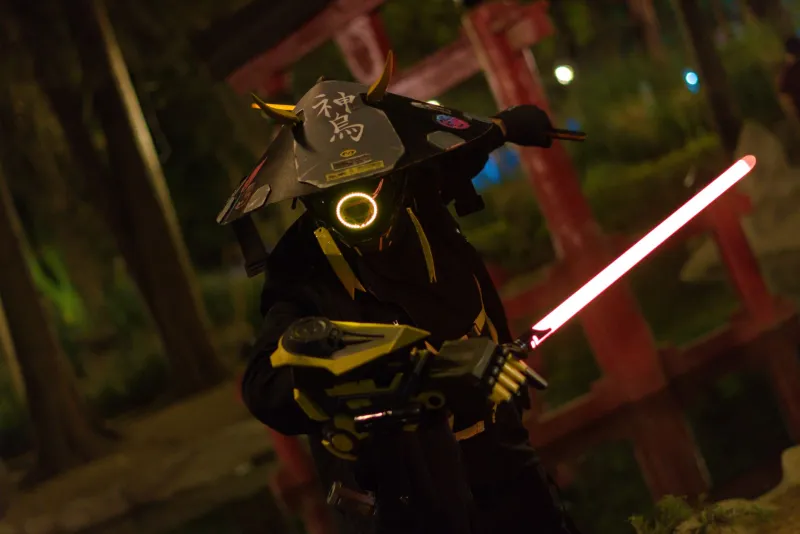
If you've ever watched a shonen protagonist scream through a power-up sequence while dramatically vowing to protect everyone they love, you might have felt something stir in your chest. That feeling? It might not just be hype. It might be the very recognizable exhaustion of someone who has been told, repeatedly, that suffering is the path to greatness.
Japan's concept of the shakaijin — literally, a "member of society," but functionally shorthand for a working adult who has accepted the social contract of duty, hierarchy, and relentless productivity — is baked into the cultural DNA of the country. And if you look closely, it's baked into anime too. Not always obviously. Sometimes it's wearing a school uniform. Sometimes it's swinging a Nichirin blade. But it's there.
The Office Under a Different Name
Let's start with Demon Slayer, because it's basically a workplace drama with better fight choreography. Tanjiro Kamado joins the Demon Slayer Corps, an organization with strict ranks, a rigid chain of command, and the expectation that members will push their bodies to absolute destruction in service of a mission they did not personally design. Sound familiar?
The Hashira — the top-tier slayers — function almost exactly like senior management in a Japanese corporation. They are revered, often unapproachable, and occasionally abusive in ways that are framed as tough love. Tanjiro's arc is essentially that of a new hire trying to prove himself worthy of respect from people who have already burned out and reforged themselves multiple times. The emotional throughline isn't just about killing demons. It's about earning your place in a hierarchy that was never designed with your comfort in mind.
What Demon Slayer does brilliantly — whether intentionally or not — is make that process feel noble rather than exploitative. The grind becomes gorgeous. The suffering becomes spectacle. And for audiences in the US who may not have grown up under the cultural weight of karoshi (death from overwork) or burakku kigyō (black companies notorious for labor abuse), this framing lands as pure inspiration rather than critique.
Kirito's Logout Problem
Sword Art Online is a fascinating case because it literally traps people in a virtual workplace they cannot escape. The game-as-prison metaphor is almost too on-the-nose. Players are locked into a system, forced to perform, and the only way out is to reach the top — a perfect allegory for Japan's seniority-based corporate ladder, where endurance is rewarded with the slow, grinding promise of eventual status.
Kirito, the quintessential lone-wolf specialist who thrives despite the bureaucracy around him, is essentially the idealized version of the talented employee who refuses to be crushed by the system. He's competent, he's quiet, and he succeeds on individual merit in a world that usually rewards conformity. For Western audiences, he reads as a cool loner. For Japanese audiences, he might read as a fantasy of escape from collectivist pressure.
But here's the uncomfortable question: does SAO actually critique anything? Or does it just romanticize individual exceptionalism as the solution to systemic problems? The show never really interrogates why the system is broken. It just says: be good enough, and you'll transcend it. That's not social commentary. That's a motivational poster.
My Hero Academia and the Meritocracy Myth
My Hero Academia might be the most explicitly ideological of the three. The entire premise — a world where your worth is determined by a superpower you're born with — is a barely veiled metaphor for Japan's hyper-competitive education and career pipeline. Quirk-based discrimination mirrors real social stratification. The pressure on UA students to perform, rank, and prove themselves under constant evaluation mirrors the juken (exam) culture that defines Japanese adolescence.
Izuku Midoriya's arc is compelling precisely because he starts without the inherited advantage everyone else has. He earns his power through mentorship and brutal training — which, on the surface, sounds like a meritocracy win. But the show complicates this by showing how much the system fails people who don't fit its parameters. Shoto Todoroki's storyline is essentially about inherited trauma from a father who weaponized his son's potential for personal glory. That's not subtle. That's a story about ambition, pressure, and the cost of excellence in a culture that demands it.
What MHA does better than most is acknowledge that the system produces both heroes and villains — and that the line between them is often circumstance, not character.
Is It Commentary or Comfort Food?
Here's where it gets complicated. These shows are wildly popular in the US, and a lot of American fans engage with them primarily as entertainment. The power fantasies are real, the animation is stunning, and the emotional beats hit hard regardless of cultural context. But stripping away the cultural scaffolding means missing a significant layer of meaning.
When a Japanese viewer watches Tanjiro bow deeply to a superior who just berated him, or sees Midoriya collapse from overtraining and get up anyway, they're likely processing something different than an American viewer who reads it as badass perseverance. They might be seeing their own life reflected back at them — dressed up, yes, but recognizable.
The danger is that for Western audiences, these narratives can accidentally reinforce the idea that the grind is glorious, that hierarchy deserves loyalty, and that individual suffering in service of a larger goal is inherently meaningful. Which is, not coincidentally, exactly what Japan's corporate culture has been telling its workers for decades.
The Fantasy Is the Point — And That's Worth Talking About
None of this means these shows are bad. It means they're doing something interesting and worth unpacking. Anime has always been a space where Japan processes its own anxieties — about identity, about modernity, about what it costs to belong to a society with extremely high expectations.
For American fans, the invitation is to enjoy the spectacle and ask the harder questions. Why does the training montage feel so satisfying? Why do we root for characters who sacrifice everything for institutions that don't necessarily deserve it? What does it say about us that we find nobility in exhaustion?
The shakaijin fantasy isn't just a Japanese phenomenon. It's global. And anime, at its best, gives us a mirror — even when it's wearing a very cool uniform and glowing with supernatural energy.
So yeah, watch the fight scenes. Feel the hype. But maybe also sit with the fact that the most compelling anime protagonists are, at their core, people trying very hard to matter in a world that made mattering extremely difficult. That's not just fantasy. That's Tuesday.